
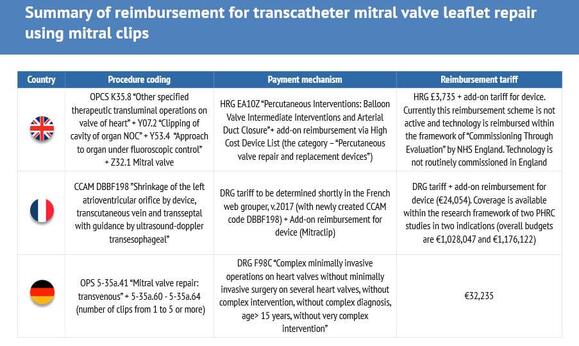
MTRC has developed reimbursement report for transcatheter mitral valve leaflet repair using mitral clips for mitral regurgitation in 11 European countries. Please, find brief summary from the report for three key European markets (England, France and Germany) below.
Reimbursement is established in Germany and France (for one indication). It is in process to be established in England and in France (for other indications).
- In England, a formal reimbursement mechanism is in place (combination of HRG-based payment for the procedure and add-on reimbursement for the device via the High Cost Device List). However, the technology is not explicitly commissioned (funded) by the national payer, NHS England. NHS England is currently funding the technology within coverage with evidence development framework (Commissioning Through Evaluation). Upon completion, NHS England will decide whether technology will be routinely funded or not
- In France, specific procedure (CCAM) code has been recently established. Reimbursement will be provided via combination of DRG-based tariff (to be determined shortly in the French web grouper, v. 2017 with newly created CCAM code) and add-on reimbursement for device via LPPR list. Procedure was selected for two government-sponsored clinical studies within Clinical Research Hospital Program (PHRC) for different indications: severe secondary mitral regurgitation - in 2012 and primary mitral regurgitation in patients at high-risk eligible for mitral surgery - in 2016.
- In Germany, the procedure is reimbursed solely via diagnosis-related group (DRG)
Policy considerations and funding landscape for the procedure are the following:
England
- Transcatheter mitral valve leaflet repair using mitral clips falls under national commissioning by NHS England. The service is defined as “Adult specialist cardiac services” provided by Adult Specialist Cardiac Centres. It includes any valve interventions. So far, the NHS reviewed provision of the MitraClip technology in April 2013. Initially, NHS England decided not to routinely commission MitraClip, but later it was commissioned within the NHS England-sponsored study framework (Commissioning Through Evaluation).
- Payment mechanism for the percutaneous mitral valve procedures includes combination of both the HRG tariff for the procedure and the add-on reimbursement for the device via the High Cost Device List (category - “Percutaneous valve repair and replacement devices”).
- National Institute for Clinical and Care Excellence (NICE) evaluated and released Interventional Procedure Guidance (IPG) for transcatheter mitral valve leaflet repair using mitral clips for mitral regurgitation (IPG 309, 2009). According to the NICE recommendations, current evidence on the safety and efficacy of the procedure was inadequate in quality and quantity and it should only be used in patients who are well enough for surgical mitral valve leaflet repair to treat their mitral regurgitation, or in the context of research for patients who are not well enough for surgical mitral valve leaflet repair to treat their mitral regurgitation.
- In England, all data in relation to heart valve procedures should be reported by hospitals to the UK Central Cardiac Audit Database
France
- MitraClip has benn registered in LPPR in December 2016 for patients with severe degenerative mitral insufficiency which is symptomatic despite optimal medical treatment, who are not eligible for valve replacement or repair surgery and who meet the echocardiographic eligibility criteria, and have life expectancy > 1 year. It was considered that in France there are about 1,350 eligible patients per year. In the assessment performed by HAS it was mentioned that added clinical value was established as substantial improvement (ASA level – II) due to lack of alternatives. HAS recommended to establish registry to collect efficacy and safety data for application with follow-up within 3 years.
- In the beginning of 2017 HAS released assessment of the next generation of transcatheter mitral valve leaflet repair using mitral clips - MitraClip NT. This new device was recommended for inclusion into LPPR with the same indication that was claimed for previous generation of device. Added clinical value was assessed as ‘no improvement’ (ASA level – V) in comparison with MitraClip
Germany
- G-BA commissioned the AQUA Institute to develop sector-specific quality assurance procedure for mitral valve interventions in 2015. Then G-BA commissioned the IQTIG to conduct feasibility study of new quality system for mitral valve interventions, the report should be prepared until 07/2017
Purchase our complete reimbursement report to get complete overview of reimbursement situation for this procedure in 11 European countries.
Subscribe to our biweekly newsletter not to miss important reimbursement information.