
Reimbursement summary for angioplasty of arteries of lower extremities with stenting using bare metal and drug-eluting stents

10

May 2017

This post presents an extract from our reimbursement analysis for angioplasty of arteries of lower extremities with stenting using bare metal and drug-eluting stents for peripheral arterial disease in England, France and Germany. 

Angioplasty with stenting using bare metal stents is reimbursed via combination of diagnosis-related group (DRG) and add-on reimbursement in England and France and solely via DRG in Germany:

  • In England, add-on reimbursement is organized via generic categories of peripheral vascular stents in the High Cost Device List
  • In France, add-on reimbursement is available via LPPR title III using either generic code or brand-specific codes for Abbott Vascular’s Xpert, Xpert Pro and CID’s Inperia Advance Carbostent
  • In Germany, angioplasty with stenting using bare metal stents is reimbursed solely via DRG. DRG and reimbursement tariff depends on number of stents inserted (one, two or three and more)
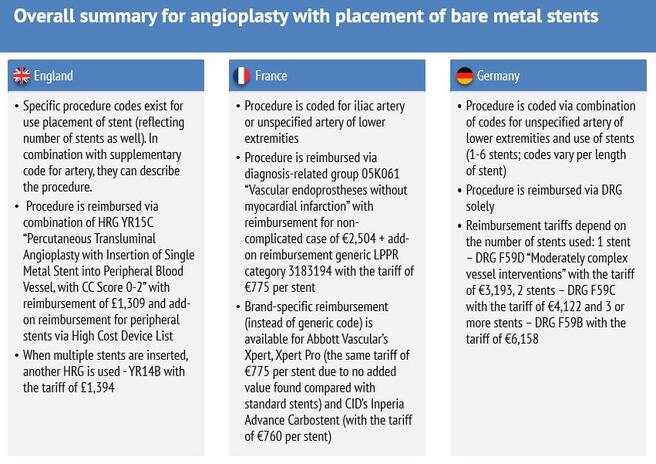
Reimbursement summary BMS

Angioplasty with stenting using drug-eluting stents is reimbursed in a similar way via combination of diagnosis-related group (DRG) and add-on reimbursement in England and France and solely via DRG in Germany:

  • In England, procedure using DES is grouped into Healthcare Resource Group (HRG, English version of DRG) with higher tariff, compared with HRG for procedure using bare metal stent. Add-on reimbursement is organized via generic categories of peripheral vascular stents in the High Cost Device List
  • In France, add-on reimbursement is available via LPPR title III brand-specific codes for Cook Medical’s Zilver PTX, Abbott Vascular’s Xience Prime BTK and four Boston Scientific’s Promus family stents
  • In Germany, angioplasty with stenting using DES is reimbursed via exactly the same DRGs as procedure using BMS
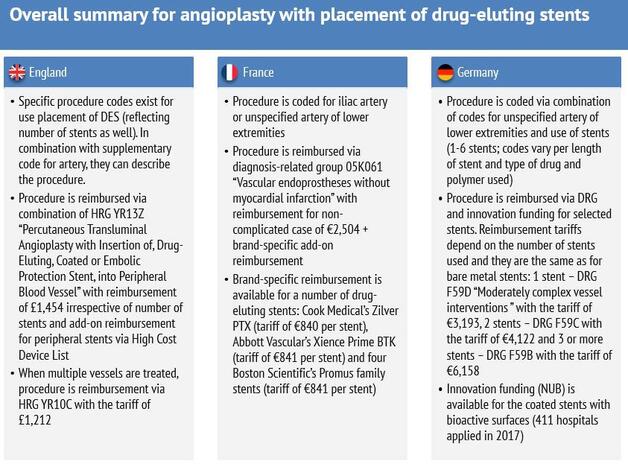
Reimbursement summary DES

Purchase our complete reimbursement report to get complete overview of reimbursement situation for this procedure in 11 European countries.

Subscribe to our biweekly newsletter not to miss important reimbursement information. 

The latest related news

24

Mar 2022

The HTA body of the Tuscany Regional Healthcare issues two types of documents: HTA forms and motivational forms. With a regional decree 2472 of February 10, 2022, Tuscany Regional Healthcare has published assessments of five medical devices of various therapeutic areas, such as cardiovascular and peripheral vascular areas.

Read more

22

Mar 2022

On February 17, 2022, the Federal Joint Committee (G-BA) has decided to include the method of matrix-associated autologous chondrocyte implantation (M-ACI) on the knee joint in the case of symptomatic cartilage damage in the lists of reimbursed procedures in the hospital and ambulatory settings.

Read more

21

Mar 2022

The NHS Insights Prioritisation Programme (NIPP) is commissioned by the NHS Accelerated Access Collaborative (AAC) and the National Institute for Health Research (NIHR). It is designed to accelerate the evaluation and implementation of innovation that supports post-pandemic ways of working, builds service resilience, and delivers benefits to patients. Fourteen projects have been funded and have now commenced activity that will be ongoing until March 2023.

Read more

18

Mar 2022

On February 22, 2022, a repository of innovative acts outside the nomenclature of biology and anatomopathology (RIHN) and a Supplementary list of IVD tests were published. Minor changes were introduced in the 2022 RIHN list.

Read more

14

Mar 2022

In February 2021, the Clinical Coding and Schedule Development (CCSD) working group, which develops and maintains procedural and diagnostics nomenclature for private payers in England, published Bulletins 0182 and 0079 with changes to be implemented no later than April 10, 2022. Three new procedure codes concerned robotic surgery in orthopaedic area, spinal procedures, and ophthalmology, and five new diagnostic codes were introduced.

Read more